
-
 The Different Types of Kitchen Knives and Their Uses
Most cutting tasks in the kitchen are achievable with a g...
Santoku Japanese Chef's Knife - How to use it?
13.07.2023 | KnivesSantoku Japanese Chef's Knife - How to use it?
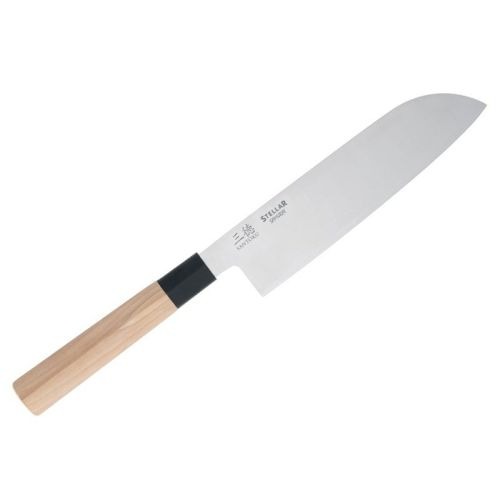
Santoku is the Japanese version of the European chef's knife. While the chef's knife in Europe is recognized by its pointed tip and convex edge, the Santoku has a slightly more rounded blade shape and a straight edge. This means that you cut differently with the Santoku compared to the European chef's knife.
But how exactly does this work? What cutting techniques is a Santoku knife used for?
Thanks to its straight edge, the Santoku does not rock on the cutting surface, as is the case with the more rounded edge of a chef's knife. The advantage of this is that the entire length of the cutting edge comes into contact with the cutting board you are cutting on. You don't have to shake the blade while cutting to use the full length of the edge. The position of the handle also helps with this. It's higher than the edge so your knuckles don't touch the cutting board.
What can you cut with a Santoku knife?
Santoku is a universal knife, the name of which is translated from the Japanese language as "Knife of the Three Virtues" (三徳包丁). The Santoku knife easily cuts the three main raw materials in the kitchen - meat, fish and vegetables. It is particularly good for cutting and chopping spices, because of the shape of the blade, but also because the Santoku is usually sharper and thinner than the European chef's knife. This makes it really easy to process vegetables into small cubes.
Cutting with Santoku
The straight edge affects the way you cut with a Santoku knife. It's worth noting that you'll rarely use just the tip. Optimum use of the straight edge is the key.
The correct positioning of the hand and fingers
The "clip" is a popular grip method among professional chefs. This is a technique where you grip the beginning of the blade between your thumb and forefinger. You fold the remaining three fingers loosely around the handle. Because you grip the blade close to the handle, you have a lot of control over what you're cutting. This means that not only do you work more precisely, but you also prevent deviations and reduce operational risk.
Does that mean gripping the handle with your whole hand is wrong? Absolutely not!
- This gives more power to your cutting motion.
- Especially necessary when cutting large vegetables such as cabbage.
But that much power is almost never needed for Santoku.
Let the sharp, thin edge do the work.
Rocking
Rocking is a cutting technique where you place the tip of the blade on the cutting board and bring the heel of the blade to what you want to cut. The tip always stays (roughly) in place and does not detach from the cutting board. This cutting technique is popular for finely cutting herbs. Ideally, the knife has a curved edge. Therefore, this technique works very well with a European chef's knife, which usually has a more prominent edge.
So how effectively this works really depends on the design of the blade.
Sliing
- The santoku knife is not a Satter, although these two knives are sometimes quite similar in design. If you use Santoku as a saber, you run the risk of seriously damaging the blade.
- Also, Santoku is generally light and doesn't have the weight of a satyr.
- With the Santoku it is possible to cut herbs, spices or soft vegetables.
Don't use too much force or you risk bending the edge, especially with Japanese knives which are quite fine.
Be creative!
The Santoku is a surprisingly versatile kitchen knife. However, it all depends on how skilled you are in handling it. There are many videos online showing chefs using Santoku in an unconventional way by filleting fish. This shows how versatile the Santoku knife is!

Related Posts